
If you own an Australian Shepherd, you already know the drill. That dog is not going to nap through the afternoon. It’s going to herd the cat, disassemble a couch cushion, or stare at you with that unnerving level of intelligence until you give it something to do. Aussies are working dogs stuffed into a family-pet body, and their jaws are just as relentless as their brains. Regular chews don’t stand a chance.
That’s where Himalayan yak chew for Australian Shepherd comes into the picture and honestly, once you try one with your dog, you’ll wonder why you spent years buying rawhide sticks that lasted eleven minutes.
This guide walks through everything you actually need to know: what these chews are, why they suit an Aussie’s specific chewing style, how to size and serve them safely, and what to watch for. No fluff, no filler, just what a decade of watching working breeds destroy (and occasionally love) different chews has taught us.
What Exactly Is a Himalayan Yak Chew?
Himalayan yak chews are made using a traditional recipe from the mountain communities of Nepal and Tibet, where yak and cow milk has been turned into a hardened cheese-like chew for generations. The basic process involves yak milk, a small amount of cow milk, salt, and lime juice, which is boiled down and pressed into dense, rock-hard sticks. There’s no artificial anything in a properly made version and it’s essentially a dried dairy product, which is part of why dogs go a little feral for it.

Compared to rawhide, bully sticks, antlers, or synthetic nylon chews, yak chews are harder, longer-lasting, and lower odor. If you’re weighing up different long-lasting chew options, our guide on A Clinical Comparison of Antlers versus Hard Cheese Chews takes a closer look at how these popular choices compare in durability, dental benefits, digestibility, and overall safety. For a breed like the Australian Shepherd that chews with real intention rather than idle nibbling, that density matters a lot.
Why Australian Shepherds Specifically Need a Chew Like This?
Australian Shepherds aren’t casual chewers. They’re bred to nip at cattle heels, grip, and problem-solve with their mouths, and that instinct doesn’t disappear just because they’re now living on a couch instead of a ranch. A few things make this breed a near-perfect match for yak chews:
High jaw strength relative to body size. Australian Shepherds typically weigh 40–65 lbs but chew like something twice their size. Softer treats get demolished and sometimes swallowed in chunks within minutes.
Herding-breed anxiety and boredom chewing. Australian Shepherds are prone to boredom and mild separation anxiety if under-stimulated. A long-lasting chew gives them a job, which is honestly the closest thing to what their brain is wired for.
Sensitive stomachs in some lines. Many Australian Shepherds, especially from working lines, do better on limited-ingredient treats. Since Himalayan yak chews for Australian Shepherd typically contain just three or four ingredients, they’re gentler than heavily processed alternatives.
Put those three traits together, and you get a breed that needs something tough, engaging, and simple which is exactly what a good yak chew delivers.
How Long Does a Yak Chew Actually Last for an Aussie?
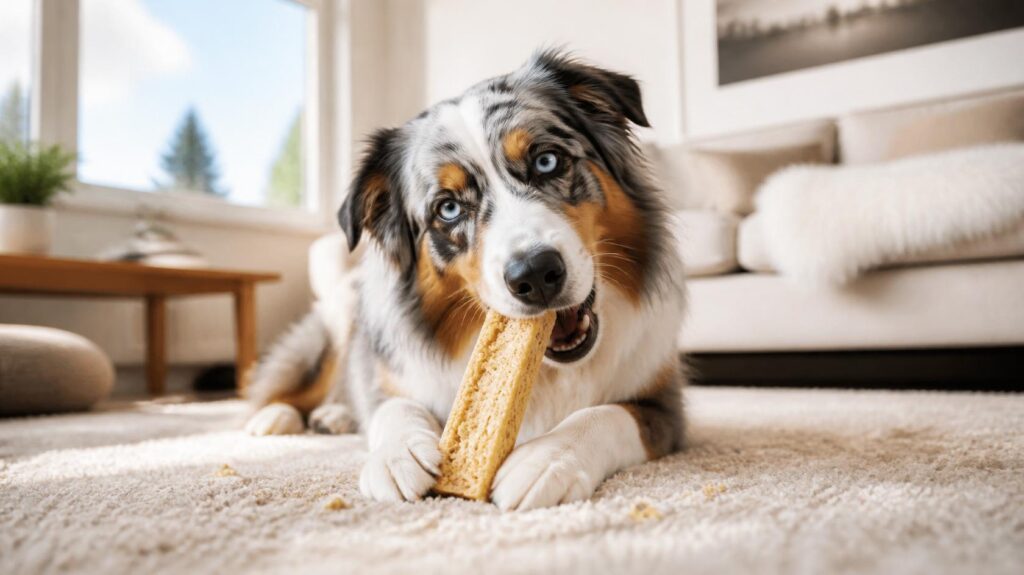
This is the question every owner asks, and the honest answer is: it depends on your individual dog, but generally longer than almost anything else on the market. A medium-to-large yak chew can last an average Australian Shepherd anywhere from one to three weeks of supervised chewing sessions, compared to a bully stick that might not survive a single evening.
Power chewers will go faster, obviously. If your Australian Shepherd treats every chew like a personal challenge, expect the shorter end of that range. But even then, you’re getting significantly more chew time per dollar than rawhide or basic nylon options.
Choosing the Right Size and Hardness
Sizing matters more than people think. A chew that’s too small is a choking risk once it gets down to a nub; too large, and an enthusiastic Aussie may lose interest or struggle to get a grip.
- Puppies and Aussies under 25 lbs: small or “puppy-grade” yak chews, which are slightly softer and easier on developing teeth.
- Standard adult Aussies (35–65 lbs): medium to large chews, the most common size for this breed.
- Larger or especially aggressive chewers: extra-large or “jumbo” sizing, so the chew lasts longer and there’s more material left once it starts to soften.
As a general rule, the chew should be roughly as long as the space between your dog’s nose and the back of their jaw. Too short, and it becomes a swallowing hazard fast.
The Microwave Trick Nobody Tells You About
Once your Australian Shepherds has gnawed a yak chew down to a small, rounded nub, don’t throw it away and don’t let them swallow it either. Pop it in the microwave for 30–60 seconds (watch it closely, it will puff up like popcorn) and it transforms into a light, crunchy, fully digestible treat. It’s genuinely one of the best zero-waste tricks in the dog world, and most owners don’t find out about it until years in.
Safety Notes Every Owner Should Know
Himalayan yak chew for Australian Shepherd are one of the safer long-lasting chew options, but safer isn’t risk-free. A few things worth keeping in mind:
- Always supervise chewing, especially in the first few sessions with a new chew.
- Take it away and microwave it once it’s small enough to be a choking hazard (roughly the size of a golf ball or smaller, depending on your dog’s size).
- Introduce slowly if your dog has never had dairy-based treats, since a small percentage of dogs can be sensitive to it.
- Avoid it entirely if your vet has flagged a dairy allergy or specific digestive condition.
Nutritional Snapshot
Himalayan yak chew for Australian Shepherd are naturally high in protein and low in fat, which fits well with the activity level of most Aussies. They’re not meant to replace a meal, but as an occasional long-duration treat, they’re considerably cleaner than most rawhide or starch-based alternatives on the market. If you’re rethinking your dog’s overall treat rotation, it’s worth pairing this with a broader look at how ingredient quality affects a working breed’s diet small swaps add up over a dog’s lifetime.
Why We Made Original Chews Yak Chews With Aussies in Mind?
We built our Himalayan yak chew for Australian Shepherd specifically sourced from small farms in Nepal, made with just yak milk, cow milk, salt, and lime juice, and sized so a real power-chewer doesn’t get through it in one sitting. The recipe itself is rooted in a centuries-old Himalayan tradition—learn more in our guide, The History of Sherpa Mountain Herders and the Invention of Chhurpi, which explores how this traditional cheese became the inspiration for today’s yak chews. No fillers, no preservatives, nothing your dog can’t pronounce.
If your Aussie has gone through every “indestructible” chew on the market and still won, it might be time to try one that’s actually built for a working breed. And if you’re not sure which size fits your dog, our chew-sizing guide walks through it in under two minutes.
Frequently Asked Questions
1. Are Himalayan yak chew for Australian Shepherd puppies safe?
Yes, in puppy-specific sizing and hardness. Wait until your Aussie has a full set of adult teeth for the standard adult-hardness chews, since puppy teeth and jaws aren’t ready for that density yet.
2. How often can I give my Aussie a yak chew?
Most owners rotate one active chew at a time rather than giving multiple per week since a single chew lasts so long, it functions more like an ongoing enrichment item than a daily treat.
3. Do yak chews smell?
Barely, especially compared to bully sticks or rawhide. This is one of the more popular reasons owners switch, especially for indoor dogs.
4. What if my Aussie swallows a big chunk?
Monitor them for the next 24 hours for any signs of discomfort, vomiting, or lethargy, and contact your vet if anything seems off. This is uncommon with proper sizing and supervision, but always worth taking seriously.