
A genuine yak chew is made from just a handful of ingredients: yak milk, often blended with cow milk, a small amount of lime juice or salt used to curdle the milk, and smoke from the curing process. That is the traditional recipe, and it has not changed much in centuries. The honest answer also includes a warning: not every product labeled a yak chew actually sticks to that recipe, and knowing what to look for on the label matters.
The Real Ingredient List
There are only four things in an authentic yak chew.
- Yak milk. The primary ingredient, sourced from yaks grazing at high altitude in the Himalayas.
- Cow milk. Traditionally blended with yak milk in varying ratios depending on region and herd availability. A chew made purely from yak milk with no cow milk at all is less common than the blend, despite how some marketing implies otherwise.
- A curdling agent. Traditionally lime juice or a small amount of salt, used to separate the curds from the whey, the same basic principle behind cheesemaking generally.
- Smoke. From curing the pressed curd blocks over open wood fires for weeks or months, which both preserves the block and gives it its low odor and characteristic color.
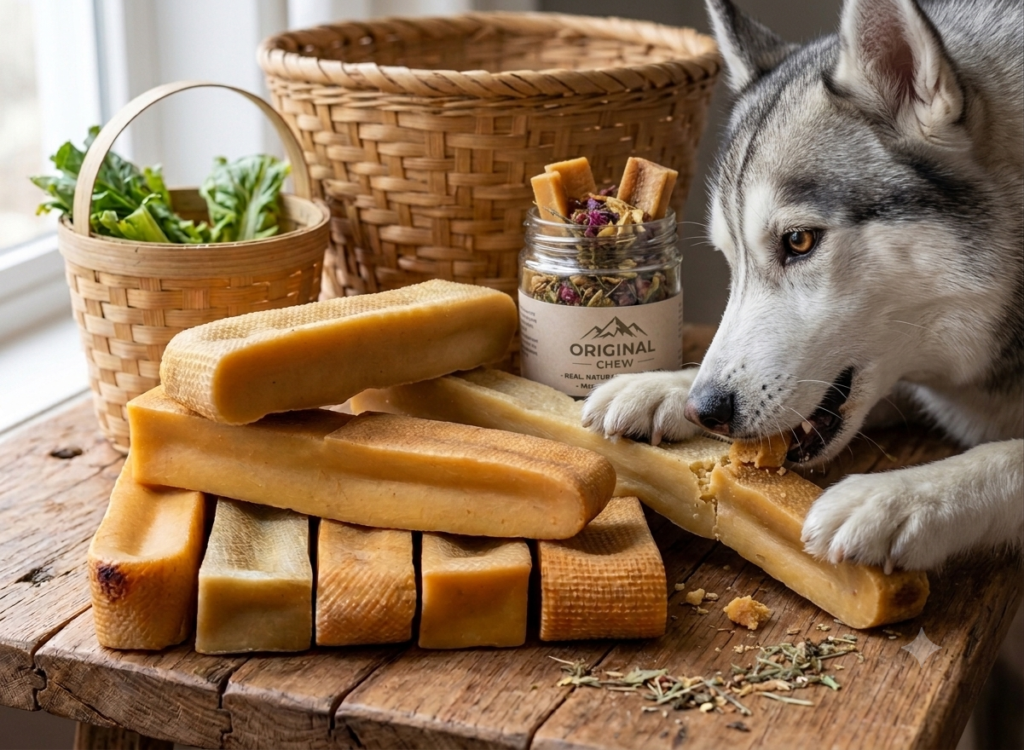
That is the entire list. No preservatives, no synthetic binders, no fillers, if the chew is made correctly. We walk through the full traditional process, start to finish, in Behind the Smoke: How Traditional Farmers in Nepal Age Authentic Chhurpi.
How the Milk Becomes a Hard Chew?
The process starts with fresh milk being curdled, which separates it into solid curds and liquid whey. The curds are pressed to remove excess moisture, shaped into blocks, and then hung or racked over smoke from local hardwood for an extended curing period, often lasting several months for a properly aged chew. The slow curing is what gives the chew its density and long lasting texture, something that cannot be replicated by fast, machine based drying.
This slow process is also why moisture control matters so much once the chew reaches you. A properly cured block is low enough in moisture to resist mold naturally, without needing preservatives.
What You Should Not Find in a Genuine Yak Chew?
If a product labeled as a yak chew contains any of the following, it has strayed from the traditional recipe, and you should treat that as a red flag rather than a normal variation.
- Synthetic binding agents or fillers, used to bulk up cheaper batches or speed up production.
- Artificial preservatives. A properly cured, low moisture chew does not need them.
- Bleaching agents. Authentic chhurpi has a natural golden amber color from the curing process, not a uniform bright white.
- Vague sourcing. If a brand cannot tell you where the milk came from or how long the chew was cured, that is worth asking about directly before you buy.
Casein: The Protein Behind the Structure
The dense, hard texture of a yak chew comes primarily from casein, the main protein found in milk. Casein is what allows the curd to form a firm, cohesive structure once pressed and cured, rather than crumbling apart. This is the same protein family responsible for the texture of aged, hard cheeses generally, and it is well documented in dairy science research on milk protein structure. If you want a more technical look at how this protein behaves during pressing and curing, see The Physics of Casein Protein Matrix Compaction.
Nutritional Profile, Honestly
Yak chews are primarily protein and fat, with the exact ratio varying by batch depending on the milk source and curing time. They are relatively low in fat compared to many rendered animal chews, which is one reason they are often considered a reasonable option for dogs who need to watch fat intake, though any dog with a diagnosed condition like pancreatitis should have their diet, including chews, reviewed by a veterinarian rather than relying on a general comparison. We avoid publishing exact macro percentages as a blanket claim here, since batch to batch variation is real and a single number would overstate precision that a natural, minimally processed product cannot guarantee.
A Note on Salt Content
Some traditional recipes include a small amount of salt during curdling, and some finished chews carry a light coating of Himalayan rock salt. In the small amounts typically present, this is not considered toxic to dogs, but salt intake should still be considered as part of your dog’s overall diet, particularly for dogs on a sodium restricted diet for a heart or kidney condition. This is a conversation worth having with your vet if your dog has an existing health condition, not something to assume is automatically fine because the product is natural.
Why Sourcing Transparency Matters Here
Because a yak chew has so few ingredients, the quality of each one matters enormously. Milk from grass fed herds grazing at altitude behaves differently than milk from industrial, grain fed lowland dairy operations, both in flavor and in the fat and protein profile of the final chew. We source through fair trade cooperatives working directly with herders in eastern Nepal and we think this kind of transparency should be the norm in this category, not a differentiator that only one brand bothers to explain.
Common Mistakes When Evaluating Ingredients
- Assuming a bright white chew is a sign of purity. It is more often a sign of bleaching.
- Overlooking country of origin on the label. Where the milk was sourced affects both quality and traceability.
- Assuming “all natural” on packaging guarantees a short ingredient list. Always check the actual ingredient panel.
- Not asking how long the chew was cured. A shorter cure time generally means a softer, faster wearing chew, regardless of what the label claims about durability.
Expert Tips for Choosing a Genuine Yak Chew
- Look for a visible, natural color variation rather than a uniform bright white block.
- Check that the ingredient list is short, ideally just milk, a curdling agent, and smoke.
- Ask the brand directly about sourcing region and curing time if it is not listed on the packaging.
- Be cautious of unusually low prices for a supposedly long cured, traditionally made chew, since curing time is a real cost that cannot be shortcut without changing the final product.
Conclusion
The honest answer to what goes into a yak chew is refreshingly short: milk, a curdling agent, and smoke. That simplicity is exactly why sourcing quality matters so much in this category, and why it is worth asking questions about origin, curing time, and ingredient purity before choosing a brand. A genuine yak chew does not need a long ingredient list to be effective. It needs a short one, done honestly.
Frequently Asked Questions (FAQs)
1. Are yak chews made from real yak milk?
Yes, authentic yak chews are made primarily from yak milk, typically blended with cow milk, curdled, pressed, and cured over smoke.
2. Do all yak chews contain cow milk too?
Most traditional recipes blend yak and cow milk, since pure yak milk in the volumes needed for commercial production is limited. A pure yak milk only chew is less common.
3. Are there any additives in a genuine yak chew?
No. An authentic yak chew contains only milk, a curdling agent like lime juice or salt, and smoke from the curing process.
4. Why is my yak chew a different color than one I bought before?
Natural color variation is normal and expected, since it depends on the milk source and curing time. A uniform bright white color is more often a sign of bleaching than purity.
5. Is the salt in yak chews safe for dogs?
In the small amounts typically present, yes for most healthy dogs, but dogs on a sodium restricted diet should have this reviewed by a veterinarian.
6. How can I tell if a yak chew has fillers added?
Check the ingredient panel directly. If it lists anything beyond milk, a curdling agent, and smoke, it has moved away from the traditional recipe.
7. What gives a yak chew its hard texture?
Casein, the primary protein in milk, forms a dense structure when the curd is pressed and slow cured, similar to the process behind hard aged cheeses.
8. Is a cheaper yak chew automatically lower quality?
Not automatically, but curing time and sourcing quality are real costs, so an unusually low price is worth asking questions about before buying.
9. Do yak chews contain grain or gluten?
No, a traditional yak chew contains no grain or gluten, since the recipe is entirely dairy based.
10. How long does it take to make an authentic yak chew?
Traditional curing can take anywhere from several weeks to a few months, depending on the desired hardness and the curing conditions.